Each individual process is working as intended. Yet the warehouse is coming under increasing pressure. That is what makes seasonal peaks and peak periods so challenging: The problem is not simply the higher order volume. It arises when material flow, staffing, warehouse equipment, and order management can no longer operate in sync.
Seasonal demand, sales promotions, and unexpected large orders cannot always be avoided. What matters is how well a warehouse can respond to increasing workloads—and how early it becomes clear where bottlenecks are developing.
Peak periods expose process weaknesses
During normal daily operations, many warehouses have sufficient buffer capacity. A delayed replenishment task, additional travel distances, or a temporarily overloaded packing station can often be absorbed. At high utilization, these reserves disappear.
A minor delay can quickly create a backlog in the next process: If goods are missing from the picking area, orders have to wait. If too many orders are released at once, the workload at packing and shipping increases. If additional staff are deployed without coordinating their tasks accordingly, the need for coordination initially grows.
Peak periods are therefore a stress test for the entire intralogistics operation. They reveal where processes depend on one another and where decisions still rely too heavily on manual coordination.
The key question is not just: What is the maximum throughput? It is: How stable does the overall process remain under high utilization?
Bottlenecks must be identified before they create backlogs
This is particularly evident in picking. When order volumes are high, inventory in picking zones runs low more quickly. If a required item is unavailable, adding more staff does little to help—the order cannot be processed further. Replenishment should therefore not begin only when a storage location is already empty. At the same time, filling every picking location to maximum capacity as a precaution is neither space-efficient nor process-efficient. Demand-driven replenishment must link open orders with available inventory.
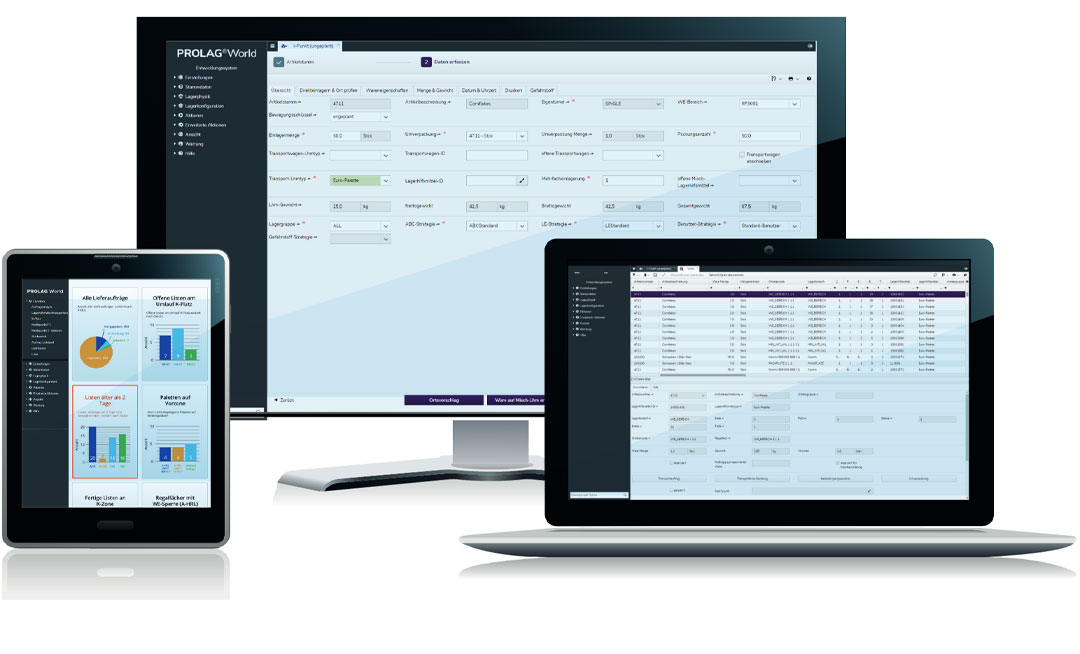
PROLAG World can automatically trigger replenishment processes, helping ensure that picking areas receive the required items in time. This turns replenishment from a reactive intervention into a controlled process.
Additional staff need clearly defined processes
Adding more staff is a common response to seasonal peaks. This may be necessary, but it does not automatically lead to a corresponding increase in throughput. New or temporary employees are less familiar with warehouse layouts and process variations. When tasks are managed primarily through experience or verbal coordination, adding more staff also increases the coordination effort.
Digital work orders, mobile devices, and scanner-guided processes can help reduce this burden. Employees receive clear work instructions, and feedback is documented directly in the system. This is particularly important during peak periods: A stable process must not depend on individual employees knowing every exception and every warehouse area by heart.
Automation must support the overall process
Even a high degree of automation does not prevent bottlenecks. Conveyor systems, automated high-bay warehouses, and other systems can move large volumes of goods. What matters, however, is whether the individual process areas are coordinated with one another. An automated warehouse area can achieve high throughput and still put pressure on the overall process if downstream stations cannot handle the quantities delivered to them. The goal is therefore not to maximize the utilization of every station. What matters is coordinated material flow.
PROLAG World combines warehouse management and material flow control, enabling manual and automated areas to be coordinated within end-to-end processes.
Effective peak preparation starts during normal operations
Preparing for a peak workload should not begin only when the holiday season or a major sales promotion is just around the corner. Many indicators are already visible in day-to-day operations: Where do waiting times occur regularly? Which items frequently require replenishment? Where are manual interventions necessary? How quickly can additional staff be deployed? Where is information missing that would enable an earlier response?
Historical process data can help identify these patterns and make preparation more closely reflect actual operations rather than assumptions. A capable warehouse management system provides a central data foundation for this purpose.
PROLAG World maps processes from goods receipt through putaway and picking to packing and shipping, and can integrate both manual and automated warehouse areas.
Conclusion: What matters is not maximum capacity, but controllability
High order volumes do not automatically throw a warehouse off track. Problems arise when processes lose synchronization: when replenishment and picking no longer align, orders enter the process without clear prioritization, bottlenecks are identified too late, or additional resources create more coordination work than additional output.
A warehouse's ability to handle peak workloads is therefore not measured solely by its maximum possible throughput. It is measured by how effectively material flow and resources can be managed as conditions change. A warehouse management system provides the transparency and process structure needed to achieve this. Peak management is not about making as much additional capacity available as possible at short notice.
It is about being able to use existing capacity effectively, even when normal daily operations are no longer normal.